Tuesday, 5 March 2013

Holidays


Last Monday I had the odd feeling of being left behind while the boats went and collected Andy Black and Jen from Carlitta. They have been working on the reindeer project and were the last ones to come out of the field. I was able to be left behind because we had signed both Rod and Joe off as RIB coxes last week. That gives us three RIB coxes (Erny is also one). I stayed behind to prepare for my working holiday. We had to get all the kit together and then biosecure it (we have to do that every time we leave the Thatcher peninsula to go to another one in the area). While I was preparing I also had to lift an engine that the military had lent us onto the Clyde so she could take it back to Stanley. Lifting something onto a warship with a JCB when you don’t know the people giving you directions can be a slightly nervous affair but we managed it and in the end I don’t think I looked as nervous as the operations officer who had sanctioned it.

Daniel, Kelvin and I left base on the boats in the afternoon and were dropped off at Sorling. It was quite an odd feeling to be the passenger on board for once and to see the boats roar off into the distance while we were left standing on the beach. After settling our stuff into the hut and a cup of tea we decided to walk over to the Nordenskold glacier to have a little look at it. The walk along the coast was lovely and we even saw some reindeer. They were the first that Daniel had seen and he was quite excited. We walked all the way up to the glacier as far as we could go. Kelvin said that the side (which often retreats quicker than the middle) had retreated by about 100m since last year when he was here. It was a little surreal to be sitting watching this glacier calve in front of us with our backs to a wall of ice that was dripping rather fast. We climbed on the scree above the glacier and saw the inside of the glacier, a view which from the boats and the shore we never see due to the angle. It was quite impressive. It is not a calm glacier, there are many, many ridges and crevasses and it is a confused jumble of blue and black ice. Beautiful but not inviting in the slightest. 

Nordenskold Glacier
 Once we had had enough of looking into the interior of the island we walked home. The shore is littered with whale bones washed up from the operations in Grytviken. There was one pelvis bone that was as long as me and when lying horizontally on the ground came up to my waist. The size of the whale from which that came must have been incredible. We had a lovely evening eating supper and watching the light of the full moon rise on the bergs. We couldn’t see the moon itself since it was behind the mountains to our back but the light on the bergs in front was glorious. We also saw the lights from the base, a very homely sight. Kelvin showed me how to find the Southern Cross and from there how to use it to find south. It is a rather more complicated method that using the North Star to find north but now at least I know. We hit the sack early because we had a long day the next day but the light from the moon kept us company all night. 
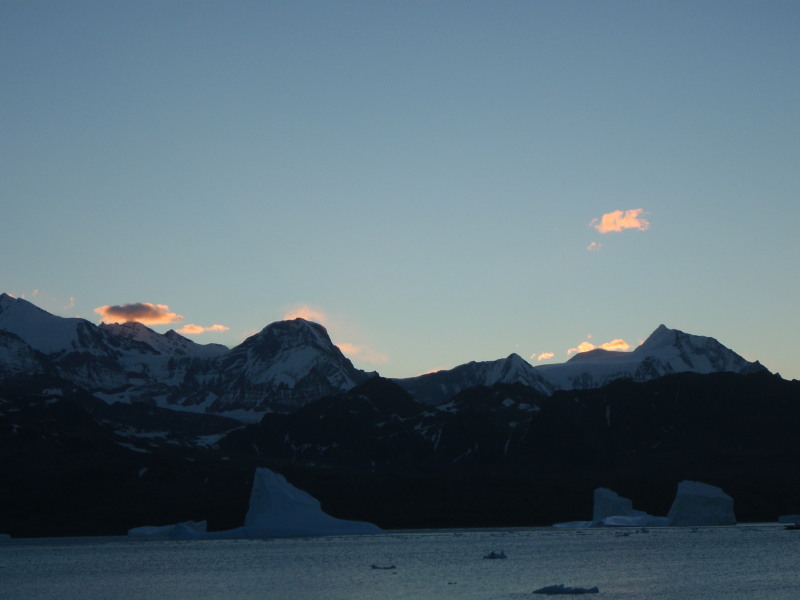
Sunset

Cooking in the hut
On Tuesday morning we awoke at 0545 and went outside to see the light of the rising sun shining strong on the hills with the moon over them. There was not a cloud in the sky and a bright bright day with air so clear you could drink it. 

Good morning!
We gobbled breakfast and then headed up the valley to climb the pass to Ocean Harbour. As soon as we came out of the bay the sun shone strong in our faces and we had to remove several layers of clothing. That walk was actually very very hot and we all regretted our thermal layers in the end. We kept to the side slopes of the valley in order to stay out of the wet bottom and pulled our way up the slope to the pass which is a low one at 250m. Once at the pass we stopped for a break and caught our first sight of Ocean Harbour. It is a smallish harbour, quite thin with a three masted steel hulk still lying on the shore where she was left in the ‘30’s when the station was decommissioned. The route that we had just walked was actually a very common one. There was a hut in Sorling, where we had spent the night, which was manned by a chap who would be brought post and some supplies from Grytviken and he would walk it over to Ocean Harbour for the whalers over there. 

Ocean Harbour
We descended into the valley and about half way down stopped and sprayed some sheep sorrel (an invasive species) that has colonised that area. We left a blue patch on the hill to show where we were spraying but it was funny to look up from the harbour and to see it there. Once we had done that we dropped into the harbour. From the shore there is a large, wide area of grass with a river running through it that goes a fair way back from the sea until it hits the sheer feet of the mountains that surround the bay. From above it reminded me of bays I have seen in Cornwall. 

There is an abandoned building (it looks like it might have been a shower block) in the middle of the open space so we made that our base. Kelvin went off and sprayed stuff and Daniel and I were left to have a look around the place. As I said Ocean Harbour was decommissioned in the ‘30’s and equipment was taken from it to supply the other whaling stations so it was left pretty clear of any infrastructure but there was still the foundations of buildings and even some lamp posts. There were also bits of machinery and an old steam train rusting on its side with coal still in its bunker.

Old Steam Train
 The place was also heaving with seals large and small. Luckily we are no longer in breeding season so the big males have gone and the whole atmosphere was rather relaxed, or as relaxed as it can be with seals. From the steam engine we walked across the black sanded beach to the other side of the cove. It was rather odd to be walking on sand since most beaches round here are rocky. The black sand reminded me of Iceland with its volcanic soils. Pat the GO wanted pictures of the graveyard for the heritage project so we went in search of that. We found only two wooden crosses still standing and the evidence of others in the ground around them. It is an awfully bleak and lonely place to be buried. At least at Grytviken the cemetery is looked after and visited, but here, no one comes and only the seals guard the dead.

Desolate Graveyard
Further along from the cemetery is the ‘Bayard’, a three masted steel bark which was used apparently as a coal hulk for the station. She is now worn so thin you can see through her hull at the water line, there is tussac grass growing on her and a colony of Shags is thriving on board. 

The Bayard
From there we walked further along the shore to the point. There we climbed a small, tussac covered hill to look along the coast. It was quite a surprise to find Furries up that hill in the tussac. Not only does one ask oneself: “How did they get up here?” but also: “Why would they want to?”. From the point we could see the ocean. It made me think that even though we live 9m from the sea we never actually see the ocean unless very briefly from a hill or as we cross the mouth of the bay to get into West Cumberland Bay. It was quite nice to see the ocean proper and some surf and to know that the next land from our shore was Tristan da Cunha.

We wandered back to the building and had lunch surrounded by Furries. They are not bothered by you at all if you are sitting or lying down, it is only when you are standing up that they have issues with you. I fell asleep in the sun after lunch and woke up to the sound of a Furry mum purring as her pup suckled. I also awoke to a ‘Geep’ (a Giant Petrel, the scavengers of the shores) at my feet looking at me and wondering if I was dead enough to eat yet. I informed him that I most definitely was not and suggested that he bugger off. I did think how odd it would seem to people who hadn’t get used to seals to see me lie down and happily fall asleep in the middle of a colony. I would not have done so if there had been big males around but I was completely happy to do so there and in fact felt quite welcomed by them when I realised they were relaxed enough, with me only a couple of feet away, to purr. 

Hide and Seek with a Furry

We left Ocean Harbour in the afternoon, once Kelvin had finished his spraying, and walked slowly back up the hill. At the pass we decided to go and visit a lake on the map so we went there and came slowly back to the hut along a ridge. We had to stop every so often because, as Kelvin said: “The view got in the way”. From the top of the ridge we could see further into the island’s interior than I had ever done before. There were far more mountains than I am used to and each of them was sunkissed and dusted slightly with snow. It really was the most wonderful sight.

The view got in the way
To top it all off when we got back to the hut we discovered that we had been living under a Sooty Albatross nest without knowing it. We only discovered it when the adult returned and started calling. The chick was silent.

Sooty Albatross and chick

Adder's Tongue Fern

Penguin footsteps in the sand
 We passed another comfortable night and returned to base the next morning when we were picked up by our boats. We discovered that it had been such a glorious day for all on Tuesday that most of the base had taken the afternoon off and gone penguin watching or fishing or anything else. Joe caught a fish surprisingly and we all teased him that now he would have to pay the £100,000 or so that it cost for a licence. 

On Friday I had a really lovely afternoon. I had discovered a couple of months ago that the parents of one of my best friends (who was my American roommate in college) were coming down to South Georgia on the National Geographic Explorer. I then discovered as an even greater coincidence that a great friend of one of my American cousins was also aboard. I organised with them and the Expedition Leader that I could give them a base tour. I caught up with them at Grytviken and brought them round to KEP. I gave them a tour and a cup of tea. It must have tasted rather odd to them since we make it with Nido (powdered milk). I had forgotten that Nido doesn’t taste quite right, I am so used to it now. I hope they didn’t mind it too much. I was then very kindly invited aboard for supper. It was someone’s birthday and as they were friends and invited to his birthday dinner he very kindly invited me also. I had spinach soup, duck breast on a lentil and chorizo base and then a cheese board made up of cheese that had not been frozen, as all ours is. There were also fresh vegetables which I happily availed myself of. I was in 7th heaven. Ellen and Ron had very kindly (at their daughter’s suggestion) brought down about 4lbs of Goldfish crackers from the US (my favourite) and chocolate. I will now have to ration it all very carefully or perhaps decide to eat them all in one blaze of glory. Unfortunately I had to leave fairly abruptly. Pat, Sarah, Andy Black and Jen who also were on board and I had to leave fast because the wind had picked up to 40 knots and if we didn’t leave quickly we would be staying on board and going back to Stanley with them. The captain brought the ship into the cove to give us some shelter and in the end it was a very dry trip back. It was a lovely evening and such a surprise. It is odd how these coincidences happen. 

Now it is back to the normal routine. Sue is in the Kitchen making the Saturday night meal as I write. The most exciting thing is that we have somehow got our hands on a copy of the new Les Miserables film and some of us have been allowed into Shack Villa (while Keiron is in Stanley having dental problems fixed) and we will be watching it for a Sunday afternoon film on sofas. I am not sure whether I am more excited about the film (which I have wanted to see for about 6 months) or sofas which we don’t have in our buildings on base. It should be a lovely day.

Monday, 25 February 2013

Ships oh ships


We have had a very calm week in comparison to the past few. We pottered along for most of Monday and Tuesday doing bits and bobs, clearing up slightly from the mess we had made the week before, putting away the 731 tools (boy did it feel like it) that we used to make Prion serviceable again. It is remarkable how many small jobs can accumulate in a week. We started very slowly getting back to grips with the AMOS jobs and making sure that we are beginning to be back up to speed with things. I think it might be another week or two till we are back up to speed but it is no bad thing to take things easy for a while.
We didn’t do any boating until Thursday when we had to drop off four people on the shore in Enten Bay to do a survey. Of course it was on Thursday that it started to snow a blizzard and the visibility dropped to almost zero. I was in Prion with Hazel and Paula was on the RIB Luna with Keiron. It turned out to be rather a long day. We were out for 6 hours in the snow in the end. I had to navigate us into a bay I had never been in before, in fog,  using only the chart plotter and radar. This is not difficult but knowing that the chart plotter can be offset (i.e. it sometimes tells you you are on land when actually you are at sea) I just wanted to be sure I was getting it right. However I thought that if I can navigate down the Thames in a lifeboat and not hit buoys, boats, rowers, bridges or the banks in the fog, I should be able to avoid ice and make it into an open bay. It was quite interesting going along in a bay where we knew there was ice but not being able to see any except for the larger chunks on the radar; we had to go fairly slowly.  When the blizzard lifted I was rather pleased to find myself in the middle of the bay, as I thought I should be.

Enten Bay has very steep sides which rose sheer above us, not as cliffs do, since cliffs have a limit, but as mountains that just rose straight out of the sea as if a great hand had just pushed rocks into sand. The valley was a bit of a bowl with a very steep bit up at the back as well. When we came into the bay all you could see was solid snow. When I was on the flying bridge and looking out for the beach all I could see were individual snowflakes flying towards my eyes, it was a very disconcerting and slightly off balancing experience. As we crept in, the snow started to shift and swirl around and a ray of light from the weakened sun came through and then the snow lifted out of the valley, it was very beautiful. We had a bit of a surprise because there was a rock which, in the swirling snow and from the angle we were looking at it, looked exactly like there was someone waiting for us on the beach.
We dropped the shore party off and then tried to anchor. It was fine until we had, of course, just got half way through our lunch, when we determined that we were actually drifting. We attempted to raise the anchor (hand pulling it up) but discovered we were just dragging tonnes of kelp. We had to get the anchor as high as we could and then cut as much of the kelp off as possible with whatever knives we had on board. It was bloody hard work but true to my geekiness, as I was bent over the side of the RIB under the bow of the jet boat, with an overloaded anchor in one hand and a rather slippery knife in the other, I did stop and look at a beautiful limpet that was attached to a big frond. It had blue rays and gills sticking out all around the edge of its shell. It was very beautiful and I made sure that it stayed attached to the frond and the frond went carefully back into the water while I remembered how much of a geek I was. It was a reminder to not anchor anywhere round here if possible.
Over the 24 hours of the weekend we had five ships in the bay. The Pharos came alongside over Friday night to take Keiron to the Falklands for a dental medivac and the final stragglers of the reindeer project. On Saturday the Ernest Shackleton came alongside to shift cargo for the rat project. Unfortunately she works on GMT time so when they came in at 0800 for them it was 0600 for us which made the day longer than it had to be. Then we had the JCR who came in with a medivac (a tooth so nothing of an emergency nature) from Bird Island. After her we had the Btanzos, a fishing vessel on which Sue was acting as observer and then later HMS Clyde arrived at the anchorage. I went out and picked Sue up from the Btanzos and dropped their new observer on board. Sue was extremely happy to be back ‘home’ and will be exacting a large dinner from what is reputed to be the best restaurant in Stanley from Martin in payment of having to be an observer.
HMS Clyde are here for 48 hours and they very kindly provided us with lunch on board. I then intimated an interest in their rigid raider and since they were doing boating expeditions I was offered a trip in her. Rod, Mickey (the builder), Hazel and I went on and we had a great time. We saw another Leopard seal from a distance and then on our way home they were called and asked to pick up one of their chaps who had twisted his knee while attempting the ½ marathon. I was able to con her into the beach and then we helped get the casualty aboard. I provided him with my spare hat, gloves and scarf and then he was able to warm up in the boat shed before being raised up to the deck of the Clyde in the ‘man cage’ of the JCB (they only have a pilot ladder for getting aboard so he couldn’t have done it). All in all it was rather an exciting day.
This coming week Kelvin, Daniel and I are going over to Ocean Harbour to spray some invasive weeds. For Kelvin it is work but for Daniel and me it is a holiday so I am rather looking forward to it. It feels like it’s time for a holiday.

Monday, 18 February 2013

Slog

For the sixth day running I found myself up and having breakfast at 0600 with an equally bleary eyed Paula. However, today was going to be the day, we told ourselves. Today had to be the day we fixed Prion and got her back in the water, there was no option, our tide would run out by Saturday (Saturday would only be possible if the pressure remained low enough to lift the water above our needed 0.8m) and the Pharos was coming alongside that afternoon to overnight so we wouldn’t be able to launch on Friday morning. If we couldn’t fix her and couldn’t relaunch her she would be stuck in the boatshed for a month and we would have no jetboat back up which is far far less than ideal! By 0730 we were already flagging. We had been in the boatshed for 6 days now and the engine bay was beginning to feel rather too much like home, with the lettering on the engine block I had been kneeling on everyday already moulded into the pre-shaped creases in my knees, God knows how Paula felt after the 6th day folded up inside the engine bay itself, losing feeling in her feet after an hour or so. We were beginning to drop tools more and more into the bilge and wiping oily green slime off them had stopped being funny on Monday. We needed a lift, a boost, a moment of inspiration, we needed... QUEEN.  And that’s what we got. The greatest hits of Queen blaring out to shatter the pre work calm of King Edward Cove with rather out of tune belting out of classics such as Bohemian Rhapsody keeping us going.
Since last Saturday we had taken her out of the water (not the easiest of jobs), serviced the jet unit, returned her to the water for testing, taken her out again because the hydraulics weren’t right, tested her again, discovered we needed to replace a thrust bearing, replaced it (well actually Erny did the replacing) and now we were putting the finishing touches to replacing the reverse cylinder so that the port bucket would work properly and we would be able to have full use of her again. All of this while continuing to do the other boating operations that were necessary.
Valentine’s day was very nearly the day we cracked. We had planned on Wednesday to have an easyish Thursday, start work at the normal time (which would have been a lie in for us), launch her, test her and then use Friday morning to get her back in again if we needed to. [At this point I should probably explain that we need at least 0.8m of tide to get the jet boats out of the water (and 0.8m is really pushing it). To get the jet boat out we need to attach the 3 tonne trailer to the JCB and an electronic winch and lower it down the slipway till the jet boat can come into it. One person then drives onto the trailer while the other stands at the trailer and when the jet boat is fully on shackles it to the trailer. The whole thing (by then weighing about 8 tonnes) then has to be pulled very slowly (the speed is dictated by the extremely slow electric winch) out of the water until, with a lot of manoeuvring and switching around, we can then pull and push it (with the JCB) into the boatshed. The whole thing takes about an hour.]
Anyway, that Wednesday night we were informed that the Pharos would be coming alongside for the night which scuppered our ability to take her out and test her again if we had to on Friday morning. That meant we had to get everything done on Thursday which is why we were to be found singing like lunatics at 0730 to Queen. Of course at 1000, the hour of our launch, the wind, which we had been watching anxiously all morning, got up to an unsafe level. We seriously had been getting no breaks in our bad luck this week! After an anxious hour we decided to put her stern in the water and see if she let in water (a real issue since we had effectively made and filled a hole by replacing the reverse cylinder (if you don’t know what a reverse cylinder is don’t worry, I didn’t either till last Monday) and we were worried we hadn’t done it right. We nervously put her in and I got into my drysuit to release her. I was in that drysuit for the next four hours getting in and out of Prion fetching tools for Paula as she valiantly changed a hydraulic pump battling against the tide. It was a nail-biting race I can tell you. To end the day we suddenly discovered at 1100 that we had to take passengers and a Government Officer out to a fishing vessel to release her so she could go home. Thank God for Hazel who provided me with lunch or else I would have perished. To make things even better I managed to do exactly the same thing as I did the day Paula arrived, I sucked most of the kelp from the bay up into my jets and was blown helplessly into the wharf behind us. At that point I came very near to canning the whole thing and going home.
Anyway, this is becoming long and boring. To cut a long story short: at 1600 on Friday, 6 days 12 hours after the whole thing started and with everybody’s help (for which we are eternally grateful) we managed to fix her!!!! We would never have done it without Erny, Joe, Kelvin and Hazel and we have promised to try and make the next service easier and quicker for everybody.
One of the good things about getting up in the early hours of the morning, as I have said before, is the often beautiful weather. Even when it wasn’t beautiful it was incredibly atmospheric with the mountains rising out of the mist and looking so like how I imagine Avalon to look that I kept expecting King Arthur to ride out demanding Excalibur.
Mists of Avalon
While we were struggling with the damned boat we had a rather exciting encounter. In the middle of all that I was standing outside the boatshed grabbing a lungful of fresh air and a break when a yacht came sailing in towing the smallest boat you have ever seen behind her. We realised that this was the 'Shackleton Epic' expedition and the dinghy they were towing behind them was in fact the 'Alexandra Shackleton', the James Caird replica they had sailed from Elephant Island. She will wait here until a cruise ship can collect her and take her back to the UK.

James Caird replica against a whaler
She is absolutely tiny, about the same size as our RIBs I think. I had a quick chat with some of the guys who did it (one of whom interviewed me for an expedition last year) and they all seemed very happy. Rather shellshocked but very happy. I think the shock of having actually done it was still very much in place and they all looked a little dazed. They all also still had their 'explorers beards' and looked rather scraggy. The chap that I had met before also looked incredibly thin. They have donated all their replica clothing, boots, stove, compass etc to the museum here and the curatorial intern was very happy but a little distressed at the artefacts still being damp from the crossing. In the end only two of them actually managed to cross South Georgia itself I think. Several of the others had succumbed to trench foot and they were hobbling rather badly. I can imagine that they would have been incredibly pleased to get aboard their support yacht and I should think they are eager to get to Stanley and a bath (showering on a yacht is DEFINITELY not the same). It was very good to see them get here  and to chat to them a little. I really take my hat off to them, they performed an incredible feat in copying Shackleton’s epic trip and were lucky to have succeeded when others didn’t. It was a coincidence also that they arrived in the week of Shackleton’s birthday, which was on the 15th. We all celebrated by having a dram for him (and for us in celebration of course).

James Caird replica
 Saturday was luckily the most beautiful day we have had for a while so 8 of us decided to climb Narval. It was a glorious day, a slow climb but that didn’t matter. The views from the top (once I had got over the height) were spectacular, you could see right down both East and West Cumberland Bays and you could see all the ice that was being blown from the glaciers. It really felt like the top of the world.

East Cumberland Bay from Narval

West Cumberland Bay from Narval
Once we had clambered down the razor sharp scree (I mean razor sharp, I sliced my finger without even realising it) we came across a couple of big snow patches that were exactly the right length and firmness to either glissade (skiing on just your boots) or bumslide down. I tried a bit of both; OK, I tried to glissade but often found myself going rather faster on my bum. It was brilliant fun and we got down far quicker than we gained it.
Peak of Narval
This weekend has been a marvellous one with both Paula and I revelling in our freedom. Next week will be calmer and we will start to catch up on everything that we neglected while working on Prion but as ever I am looking forward to it and to seeing what it will bring.
Chinstrap Penguin

Monday, 11 February 2013

Migration Week


This was a week of massive coming and going. We lost 10 people from base and have gained an entire rat eradication team of 20 people and 3 helicopters. For the second week in a row we thought that we might have a chance at a quiet one and yet again our thoughts were found to be incorrect. On Monday we had an exhilarating trip round into West Cumberland Bay to Carlitta. There we were picking up Martin who had walked over from Husvik, giving the soil beakers a chance to collect some samples and then we were taking them to Harpon to be dropped off for the night. 

The conditions we were in were interesting. I say ‘interesting’ to describe borderline weather when writing to my mother but unfortunately she has deciphered my code and now can get slightly nervous when I email her describing interesting weather. Through my service with the lifeboats I have become used to dealing with interesting weather but normally I am in a boat that is 2m longer and has 60 more horse power than the RIBs we work with here. It was quite illuminating to see the difference that 2m and a little extra power can make to the comfort of a passage. Of course it was never dangerous. We would not go out in anything dangerous. We knew it was a little gusty but Paula and I discussed it and decided that we were happy with it. In the afternoon we had to pick up four guys who were on the Barff and that also involved some interesting weather and two interesting transfers from the RIB (which we use to pick people up from shore) to the jet boat but  apart from Joe (the sparky) being slightly nervous all was fine and we made it home for tea and medals. It is remarkable how tiring driving in those conditions can be but it was great fun. 

The chaps we had picked up from the Barff were all Norwegians working on a project here and the night after they arrived they concocted a feast for the entirety of the base. It was slow roasted reindeer (at 70’C for 16 hours) with potatoes, veg and ‘brown sauce’ (gravy with cream). It was one of the most delicious meals I have ever had and it was made all the better by the wonderful weather we had after the wet misery of the day before. 

On Thursday we went for the second Fur seal pup weighing. This was exactly the same as last month’s except that the pups were bigger, feistier and better at hiding. Luckily we had a big team and we managed to do it fairly quickly but wandering around the beach were some rather large males who seemed to take exception to our trying to weigh pups, even if they weren’t theirs. Then once we had caught our 50 from the beach we moved into the tussac which always to me feels like wading into a jungle with no idea of what exactly you will find in there. One of the pitfalls (quite literally) of tussac grass is the trenches and wallows that if you are not careful you can find yourself up to your waist in. I was fortunate that the Ellie wallow that I managed to find had recently been vacated by its owner, I am not sure that the Ellie would have appreciated my stepping on her back, I might have smelt a little better though. 

Puppy exploring the boatshed
It's been a long day

On our way to the weighing beach we had to pass Puppy Lake and it truly lived up to its name. When you go to Maiviken you descend through scree to the hut and then you leave the hut behind and drop into the bowl of Maiviken itself. Dropping into here is like dropping into the Lost World. After the scree you have just traversed it is lush and green with bunches of tussac perfect for velociraptors to come running at you out of. Except that it is not velociraptors but Fur seals. The pups are so sweet. They try to be so big, bad and fierce and they sometimes growl at you so hard that they fall over. It is wonderful but rather primal walking through this sometimes neck high tussac with growls reaching you from unseen ‘beasts’ from every angle. As we walked past Puppy Lake you could see from a distance that the surface of the water was seething and boiling. When we got closer it turned out to be hundreds upon hundreds of pups playing and gambolling in the water, learning to become the flashes of silver that are their parents at sea. 

Puppy Lake

We finished pup weighing and had a typically British picnic with us all sitting on the beach in the sun and spitting rain, surrounded by slightly pissed off Fur seals, every so often bracing against gusts of wind that were up to about 50kt (a hurricane is 64kts) which would fling hail and spray painfully at us and annoyingly whip up the few crisps that we were sharing and blow them into the bog. It seemed completely normal but when I think back on it was slightly surreal. 

On Friday the mass exodus commenced with 10 pax (passengers) being taken by the JCR (James Clark Ross, one of the BAS ships). All the met beakers (weather scientists) and the soil beakers left, as did our beakers’ boss, Mark Belchier, and another chap who had come down to help with the groundfish survey. We then took two of the Norgies (Norwegians) back to the Barff. We slowly picked our way through the brash ice that had formed from the breakup of some of the icebergs that have blown in over the past month or so. One thinks that an iceberg is white until you see the cracks that run deep into its middle which are a deep, rich blue and then you see a snow petrel fly in front of the berg and while you would think that they would be the same colour this one snow petrel was picked out with perfect clarity against the almost blinding white. While making our way through the ice we suddenly spotted a Leopard seal. These are vagrants in these waters but they can be seen lying up on ice floes (as this one was) close to the glacier. We edged closer to have a look. I was in the 5.5m RIB and it was quite a shock when we realised that this animal was probably about 4m long. It wasn’t bothered by us at all and would slowly raise its almost reptilian looking head and look at us and the look that it gave us was slightly chilling because it was one of a predator that knew no matter what happened, it was top dog and we could never even come close to it in power. I am very pleased to have seen one but I am rather glad that, feisty and vicious though they can be,  we have Fur seals as the main residents on the island and not Leopard seals.

After the massive high seeing that Leopard seal gave us (Paula and I commented on how we actually get paid to see such sights) things came back down to normality on Saturday when Paula and I got up at 0530 to get one of the jetboats out of the water to service her. It always seems in the boating world that the tide that you need is at silly o' clock but we were more than compensated by the incredibly beautiful light on the hills behind Grytviken and the clarity of the air. Any time that I am up around 0600 here I have always noticed that the weather is at its best. Whether that is because the clouds haven’t formed because the land is cold, or for some other reason, it definitely makes getting up at that time worth it.


Early morning light from the boatshed

Prion on her trailer

We worked solidly on the jetboat all day, pausing only to take the other two Norgies to Jason Harbour in West Cumberland bay. It is an incredibly beautiful place and I am only sad that it is not within our travel limits because I would love to wander around there and explore the place a little. Hazel topped the day off with a fantastic Saturday meal of sweet potato and coconut soup, lamb tagine with couscous and brandy snaps with ice cream, tinned peach slices and raspberry coulis. It was glorious. 

Sunday was yet another early start for me since I was on earlies but also for the rest of the base since the Ernest Shackleton (or the Shack, the other BAS ship) came in at 0600 with the Habitat Restoration project aboard. This project is also affectionately known as ‘team rat’. They are here to eradicate rats on South Georgia. By doing so they will greatly increase the population of all birds on the island (since rats eat bird eggs and chicks) and they will restore the island to a condition that it has not seen since the first rat came ashore (possibly with Captain Cook). It is an ambitious plan and South Georgia is the largest island on which rat eradication has ever been attempted. They are chartering the Shack for a couple of weeks to depot gear all over the island in field camps. There are about 20 people who have come down as volunteers including 4 helicopter pilots, helicopter mechanics, 3 chefs, mapping and GIS guys and a whole team of general workers who will mainly be refilling the large bait hoppers that are underslung from the helicopters. It was very impressive to see three helicopters craned out from the bowls of the ship, the blades put on and half an hour later to see them taking off and buzzing around Mount Duse, which more usually has albatrosses circling its peak. 

Alpha Sierra

This is going to be a busy period for the whole island. There will be no bait dropped on Thatcher peninsula since it was cleared 2 years ago but the rest of the island to the north will be alive with the sound of choppers baiting all hours of the day. More prosaically for us, next week will involve launching Prion again on Monday morning and bringing Pipit out for her service which will hopefully be done before Wednesday when we have the last day of tide in which we can get them in and out of the water. Perhaps after Wednesday Paula and I can get some sleep. Somehow I think that the world outside my window will call too loudly for me to waste time sleeping and I will use my down time to explore further afield